

In each edition of The Solar Report, we shine a spotlight on one of our valued Platinum Business Members through an exclusive interview. In this issue, TXSES Communications Director Tamara Kowalski connected with Supratim Srinivasan, CEO and Co-Founder of Atma Energy, to learn more about the company’s mission, it’s vision for the future, and how its work is making a difference for solar customers.
Company & Mission
What inspired you to start your company?
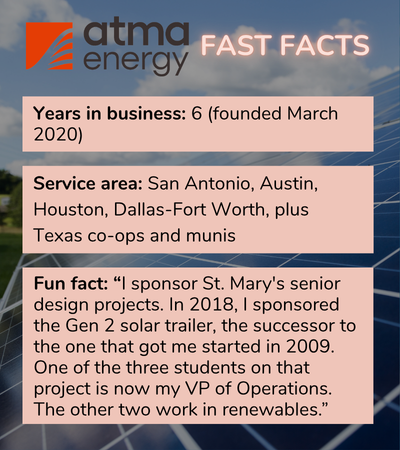
A solar trailer at Fiesta Oyster Bake (an annual event at St. Mary’s University, San Antonio). In 2009, my professor at St. Mary’s, Dr. Rezaie, asked a few of us to make the event greener. We built a mobile, battery-backed solar trailer with nine panels that powered 35 booths. It won the San Antonio Green Building Award that year. That was an “aha” moment—distributed energy works, and people get it when they see it. Eleven years and a few solar companies later, I started Atma in March 2020 to do solar the way an engineer would do it for his own home—right-sized, transparent, and serviced for 25 years.
How long have you been working in the solar energy field?
Since 2009. 15+ years professionally. I was lead engineer on CPS Energy’s SolarHost program, then VP of Engineering at Big Sun Solar before starting Atma.
What do you enjoy most about working in solar energy?
The homeowner’s first bill after PTO (Permission to Operate—final approval from the utility company to connect to the electrical grid and start generating electricity). Everything else is engineering. That moment is why we exist.
What is your company’s mission, and how does it show up in your daily work?
Make energy independence simple, honest, and affordable for Texas homeowners. Daily, it shows up as three rules: do the right thing, make a positive impact, value people. Practically, it means no hidden surprises in pricing, production, or timeline, and a service department that picks up the phone in year eight, not just year one.
Your Work & Expertise
What services do you offer, and what sets your company apart?
Residential and commercial solar, battery storage, whole-home backup, service and warranty work on any brand, PE-stamped electrical design, and VPP operations. What sets us apart—we are engineers and a licensed electrical contractor (TECL 39085), we build our own software, and we hold U.S. Patent 11,381,090 on front-of-meter VPP architecture. We are San Antonio’s only Enphase Platinum installer and the 2026 EnergySage Local Installer of the Year for Texas with a 5.0 rating.
What types of projects are you most proud of?
The Bandera Electric Cooperative VPP—2 MW across 129 homes, ERCOT-qualified, the first program of its kind on a Texas co-op. It proved residential batteries can serve the grid, not just the garage. Second, the orphaned systems. When companies like Freedom Forever and TriSMART folded, we picked up their customers and got their systems running again. Those homeowners did nothing wrong.
Who is your typical customer or client?
Suburban Texas families, 35–55, who have done the math and want a straight answer. They care about ROI, backup during outages, and who will still be around to service the system. We also work with school districts, co-ops, and commercial owners who need storage designed and permitted properly.
What’s something people might be surprised to learn about you or your team?
We write our own software. The CRM, proposal engine, project tracker, and service portal our team uses every day were built in-house—no off-the-shelf tools. Also, Atma has a running club. We set up and train for marathons together. Last year four of us ran the San Diego Marathon.
What’s one common misconception people have about going solar?
That the federal tax credit going away killed the math. It changed the math. Electricity rates in Texas keep climbing, outages keep happening, and equipment costs are down. A right-sized solar and battery system still pays in Texas. The bigger mistake is buying the cheapest quote from a company that will not exist in three years.
Texas Solar Landscape
What are you seeing in the Texas solar market right now?
A reset. Roughly 100 national solar companies have closed in the last 18 months. Fly-by-night sales shops are leaving because of SB 1036, which took effect September 1 and requires TDLR registration and a licensed electrical contractor on every contract. Inbound demand to local, licensed installers is up. We took 43 service tickets in two weeks from systems we did not build. Utility rebates still matter—Oncor’s is up to $9,000 and New Braunfels Utilities still offers net metering plus a $3,000 rebate.
What challenges or opportunities do you think are most important for the industry in Texas?
There are three:
- Orphaned customers. Tens of thousands of Texans own systems with no one to service them.
Solution: licensed local installers need to step in, and TDLR enforcement under SB 1036 needs teeth. - Fair value for rooftop solar. Munis and co-ops set buyback rates however they like.
Solution: the legislation TXSES is working on to require a true value of solar. - Load growth. Data centers and transmission costs are coming onto every ratepayer’s bill.
Solution: residential batteries in VPPs. ERCOT’s new DER registration system opens the door. Texas homes can be the grid’s cheapest capacity.
What advice would you give to someone considering solar for their home or business?
- Check the installer’s TECL license and TDLR registration before you sign.
- Buy the right size, not the biggest. ROI first.
- Ask who services the system in year eight and what the warranty actually covers.
- Add a battery if outages or peak rates affect you and ask if it can enroll in a VPP.
- Get your proposal’s modeled production in writing and compare it to actual after year one.
Why TXSES Membership?
Why did you choose to become a TXSES Business Member?
Because Pete and the team fight for homeowners at the Capitol, and installers who do it right need a seat at that table. Value-of-solar legislation, unlicensed roofers selling solar, consumer education—that is the work. We came in at Platinum and sponsored a table at the 50th Anniversary because it is the right thing to do.
Why do you think organizations like TXSES are important for the solar industry and consumers?
Consumers have no referee. TXSES is the independent voice—no commissions, no equipment to sell. For the industry, it is the only place installers, utilities, and policy people in Texas sit in the same room. Fifty years of that matters.
Looking Ahead
What’s next for your company in the coming year?
Scaling VPPs. We proved the model at Bandera Electric Cooperative—2 MW, 129 homes, ERCOT-qualified. 2027 is about running that playbook with more co-ops and munis on our platform, enrolling the batteries we install into programs that pay homeowners, and making every new install VPP-ready on day one.
Alongside that: 1) scale service across Texas for orphaned systems; and 2) longer, simpler financing—25- to 30-year loans, not leases. The goal is to be the largest residential solar and storage company in Texas by 2027.
What are you excited about for the future of solar in Texas?
Texas will need more electricity than any state in the country, and it is an island grid. Rooftop solar plus batteries is the fastest capacity you can build—90 days from contract to PTO versus 5 years for a gas-powered plant. The installers left standing are the ones who did it right. That is a good place to be.