
Rural communities didn’t get into renewables for politics. They did it because it worked. They need stability, not sudden rollbacks.
By Raina Tillman Hornaday, TXSES Board Member
Austin American-Statesman Guest Columnist
Aug 8, 2025
Read it in the Austin American-Statesman.
The recently passed “big, beautiful bill” was marketed as a cost-cutting win. While that may be true for some parts of the U.S. economy, the immediate impact for rural America’s energy — and for those of us building the future of energy from the ground up — is bleak.
By rolling back key parts of the Inflation Reduction Act, including the clean energy tax incentives and U.S. Department of Agriculture’s REAP grant funding, President Donald Trump’s “big beautiful bill” has made it harder for farmers, ranchers and landowners to access the tools they need for energy independence and economic resilience.
These policy changes aren’t just about spreadsheets in Washington. They have real consequences on the ground. In Texas, more than 35 gigawatts of new solar power are expected by 2028, much of it on private land in rural counties. These are not speculative ventures. They’re practical decisions by landowners who’ve seen firsthand how clean energy can stabilize income, lower costs and keep the land in productive use.
The sudden cancellation of the July 1 REAP application window left many of those landowners — and the developers working with them — in limbo. Projects that were ready to go are now shelved, delayed or defunded.
That kind of uncertainty sends the wrong message to the communities that have done everything right.
I know these communities because I come from them. My family homesteaded in eastern New Mexico in 1906. They arrived in a covered wagon, lived in dugouts and hauled water for miles just to survive. I was raised on a dryland wheat farm where we grew or raised just about everything we ate.
That upbringing taught me the value of resilience, resourcefulness and deep respect for the land. Today, I bring those same values to my work building utility-scale solar, battery storage and custom microgrid projects in rural communities across Texas and the Southwest.
This work isn’t abstract. One of our proudest projects is a solar-powered microgrid for Dos Rios Winery, a working vineyard in historic Rio Grande City. In partnership with the University of Texas Rio Grande Valley, we built a system that delivers clean, reliable energy — without interrupting agricultural production. It’s a living example of how renewables and traditional land use can coexist and even thrive together. And it’s not a one-off. We’re scaling this model to farms and ranches across the state.
Microgrids, in particular, have become an essential tool in a time of increasing grid instability. Texas leads the nation in power outages, and rural areas suffer the most — longer transmission distances, older infrastructure and fewer redundancies mean longer recovery times. Microgrids provide local, resilient power that helps farms and homes stay online when the grid can’t. That’s not just about convenience. It’s about survival.
And still, despite these clear benefits, clean energy faces political headwinds. While Texas lawmakers did pass Senate Bill 6, which takes small steps to improve interconnection and support grid resilience, more work is needed to ensure rural energy solutions aren’t buried in red tape or priced out of reach. When federal and state policies pull in opposite directions, rural communities are caught in the middle.
Rural communities didn’t get into renewables for politics. They did it because it worked. Because it added value to their land, strengthened their operations and gave them more control over their future. They need stability, not sudden rollbacks.
On the state level, SB6 is a good start, but Texas policymakers must provide more funding and grant support for farmers and ranchers who demonstrate that clean energy aligns with rural values. They should also explore adopting the same financing, leasing and regulatory frameworks that oil and gas projects enjoy.
At the very least, renewable energy deserves a level playing field, one that affords the same regulatory certainty and adjustment period that traditional power sources have long enjoyed. The sudden and sweeping policy changes at a federal level not only undermine investment but risk destabilizing our state’s energy sector, which is critical to Texas’s economic future.
As an energy powerhouse, Texas is uniquely positioned to lead. Our state legislators should provide support ensuring the communities that built Texas’ energy legacy remain integral to its future.
Raina Tillman Hornaday is a renewable energy developer, the co-owner of Caprock Renewables and Fortress Microgrid, a fifth-generation rancher and a board member for energy organizations CleanTX and Powerhouse Texas.
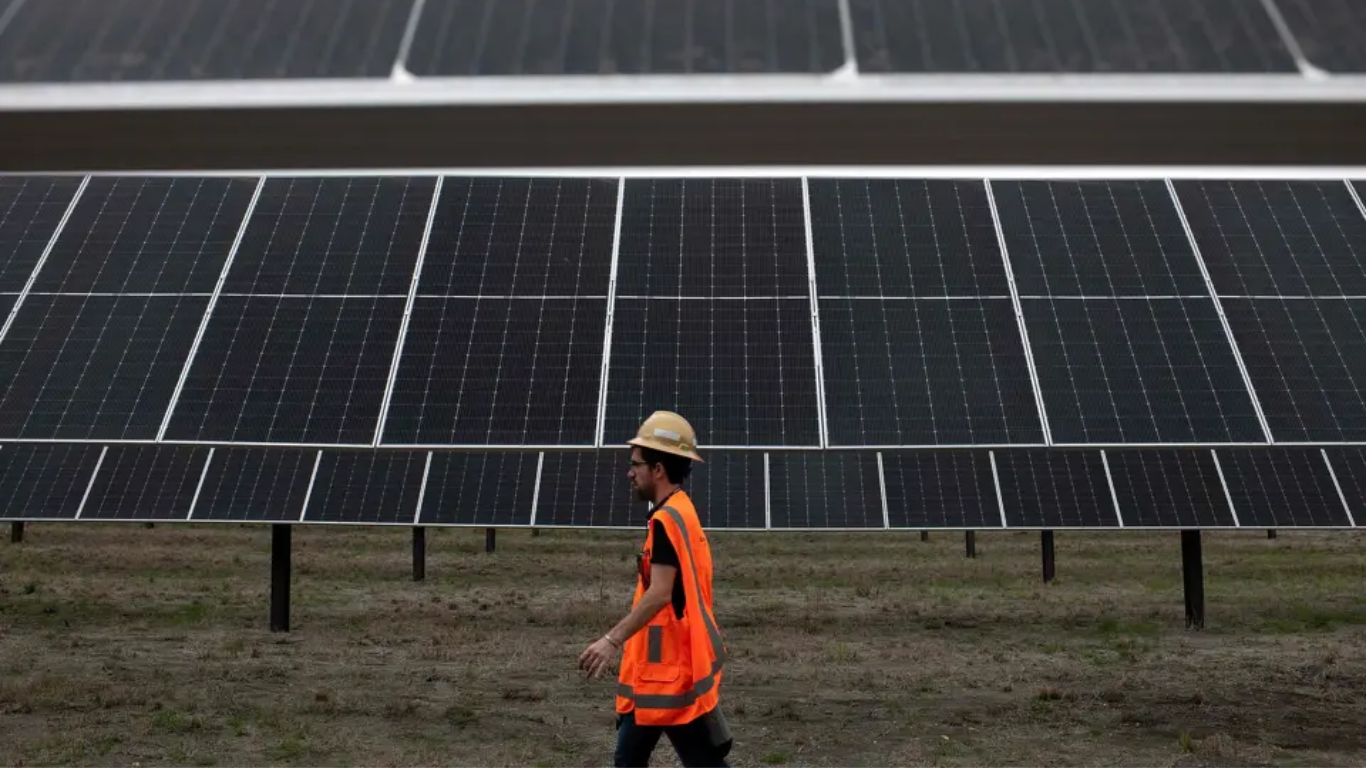
Image: An ENGIE employee walks past solar panels in 2023 at the ENGIE Sun Valley Solar project in Hill County.
MARK FELIX/AFP /AFP via Getty Images